What Constitutes Inventury Review in Pharmacy for Medicaid Ffs Proof
Managing the Medicaid prescription drug benefit and pharmacy expenditures is a perennial policy priority for state Medicaid programs. Though Medicaid prescription drug spending growth has slowed in recent years, like to the overall US trend, land policymakers remain concerned about Medicaid prescription drug spending growth. Since the structure of the Medicaid Drug Rebate Program ways that land Medicaid programs essentially must encompass all drugs, states cannot limit the scope of drugs covered in an endeavour to control drug costs. Instead, states have typically used an array of utilization controls to manage utilization of prescription drugs. The administration of the chemist's shop benefit has evolved over fourth dimension to include commitment through managed care and more than reliance on pharmacy benefit managers (PBMs). Even so, equally costs continue to grow, the utilize of managed care and PBMs has expanded, and new "blockbuster" drugs come up to market, states face new challenges in managing pharmacy benefits. This cursory explores cardinal questions about state management and delivery of Medicaid chemist's shop benefits, including:
- What tools have states traditionally used to manage drug utilization in Medicaid?
- How has the administration of the pharmacy benefit evolved over time?
- What are current policy debates and proposals about Medicaid pharmacy management?
What tools accept states traditionally used to manage drug utilization in Medicaid?
Nigh states use an array of measures to command utilization of prescription drugs in Medicaid. Under federal rules regarding the federal rebate agreement and medical necessity requirements, states take flexibility in administering their Medicaid prescription drug programs. Equally pharmacy expenditure growth became a greater Medicaid budget concern in the late 1990'southward and early 2000's, most states implemented pharmacy cost containment strategies, including preferred drug lists (PDLs), supplemental rebate programs, state maximum allowable cost programs, multi-state purchasing pools, and prior authorisation policies linked to clinical criteria. Prescription drug costs continue to exist an expanse of concern for states, though growth has slowed from a peak in 2014 (Figure i). States go along to routinely update and refine their drug utilization controls to respond to changes, particularly new product offerings, in the pharmaceutical market place. In addition, states may implement prescription limits or impose casher cost-sharing for certain groups to command prescription drug utilization.i , 2
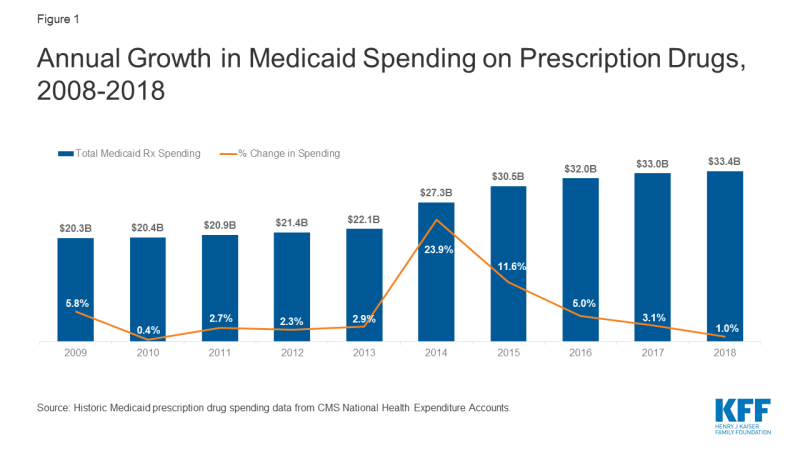
Effigy i: Annual Growth in Medicaid Spending on Prescription Drugs, 2008-2018
Preferred Drug Lists
Most state Medicaid programs maintain a preferred drug list (PDL) of outpatient prescription drugs, which is a list of outpatient drugs states encourage providers to prescribe over others. At least 45 states use PDLs in their fee-for-service (FFS) drug programs.3 , four A state may require prior authorisation for a drug non on a preferred drug listing or adhere a higher co-pay, creating incentives for a provider to prescribe a drug on the PDL when possible. Since states are required to make available most all prescribed drugs from manufacturers with a national rebate agreement in both managed care and fee-for-service settings, PDLs allow states to manage utilization. In improver, PDLs often include drugs which are lower-cost or for which a manufacturer has provided supplemental rebates, as PDL placement is a chief lever that states use to negotiate supplemental rebate agreements.
Prior Authorization
One of the primary tools country take long used to manage the utilization of drugs is prior authorization. Prior authorization requires prescribers to obtain approving from the state Medicaid agency (or its contractor) before a detail drug can be dispensed.5 Goals of prior authorization include encouraging patient adherence, ensuring appropriate utilization, and discouraging waste material.vi Prior authorization processes for covered outpatient drugs must encounter 2 federal requirements: 1) they must respond to requests for authorization within 24 hours; and, 2) they must make bachelor a 72-60 minutes supply of medications in an emergency situation. Medicaid managed care plans' prior potency procedures must meet the same criteria.7 All states apply prior authorisation in FFS drug programs and at least 30 states utilise the aforementioned prescription criteria to FFS and managed care for one or more drugs.eight , 9
States may require prior dominance for any drug covered by Medicaid only often do so for high-cost specialty drugs or non-preferred drugs. Prescriptions for non-preferred drugs (i.e., those not on the PDL) often require prior dominance. States may also require prior authorisation for newly approved therapies while they examine the drug's effectiveness and prophylactic.
Drug Utilization Review (DUR)
States are required by federal police to take a drug utilization review (DUR) programme in place to help ensure appropriate drug utilise. 10 Drug utilization review programs must establish standards to ensure prescriptions are appropriate, medically necessary, and unlikely to lead to adverse medical results. DUR programs must too include evaluation for problems similar duplicate prescriptions, incorrect dosage, and clinical misuse.xi
DUR is a ii-footstep process conducted by country Medicaid agencies, consisting of both prospective and retrospective drug utilization review. In prospective DUR, state Medicaid agencies employ electronic monitoring systems to screen prescription drug claims for concerns similar duplicate prescriptions, incorrect dosage or duration of treatment, contraindications, and clinical misuse or corruption. Retrospective DUR is ongoing and involves periodic exam of claims data to identify patterns of fraud, abuse, underutilization, and medically unnecessary care.12 States are required to plant a DUR board to create the standards for appropriate drug utilise and to carry retrospective drug utilization review. The board membership must consist of at least two-thirds physicians and pharmacists.13
Federal law requires states to make an almanac DUR report on their Medicaid prescribing patterns, price-savings associated with DUR, lath activities and programme operations. According to CMS, states saved an average of $57 one thousand thousand in 2017 through prospective DUR, and $one.46 million through retrospective review.14 However, due to heterogeneity in the methodologies used by states to summate savings, comparisons of program cost-savings betwixt states are unreliable.15
Chemist's & Therapeutics (P&T) Committees
To establish a PDL, federal law requires a land Medicaid agency to establish a commission of physicians and pharmacists to inform the development of the PDL, review drugs, and develop coverage decisions. xvi In many, but not all, states, these activities are performed by a pharmacy and therapeutics (P&T) committee. In general, P&T committees are responsible for reviewing data on drug effectiveness and issuing prove-based recommendations on coverage criteria, such as placement of drugs on the PDL and utilization controls. In improver to effectiveness and safety, the committee may also factor in price considerations to their decisions. P&T committees also may utilise contractors to assist in reviewing bear witness, usually the state's PBM or an academic institution in the state. States as well accept the pick under federal law to use their drug utilization review board to fill this role.17
Since there are few federal requirements for P&T committees, the limerick, structure, and operations of P&T committees may vary from state to state. Federal requirements for committee composition specify pharmacists, physicians and other "appropriate" individuals, but otherwise leave states with flexibility for determining committee operations.18 Meeting frequency and procedures tin vary between P&T committees. Under federal Medicaid rebate rules, states are required to cover all drugs from a manufacturer that has a rebate agreement in identify one time they are canonical past the FDA and enter the market place. This requirement means states must chop-chop decide how to categorize the drug and if it volition be on the PDL.19 States oftentimes require prior authorization of a new drug before information technology is reviewed past the P&T commission and clinical guidelines are adult. The length for the evaluation of a drug and development of coverage criteria is typically one to three months but tin can exist every bit long equally one twelvemonth.xx It oftentimes takes longer for committees to review breakthrough or offset-in-class drugs and therapies than for a new formulation of a drug or a new drug in an existing grade.
Cost-sharing and Prescription Limits
States accept the authority to implement cost-sharing to control utilization and costs of prescription drugs. For case, states may implement different co-payments for drugs on a preferred drug list or generic drugs, compared to non-preferred or make drugs. Most states now utilize some measure of price-sharing in their Medicaid pharmacy benefit. In fiscal twelvemonth (FY) 2018, 35 states and DC reported having co-payments for prescription drugs in place for Medicaid non-exempt beneficiaries.21 Co-payments are statutorily capped at $four for preferred drugs. For non-preferred drugs, states may require co-pays up to $8 for most beneficiaries with income at or below 150% of the federal poverty level (FPL).22
In addition to implementing cost-sharing, states may limit the number of prescriptions a casher may access without prior authorization. These restrictions may include a limit on the total number of prescriptions per month or a limit on the number of brand drugs. Medicaid programs allow prescribers and pharmacists to submit prior authority requests to override these limits when medically necessary or under other specific circumstances, discipline to federal requirements for prior authorization processes. In addition, states are authorized nether federal law to set minimum or maximum numbers of pills or doses per prescription as well every bit the number of refills.23 In guild to implement prescription coverage restrictions that are not expressly permitted by federal statute,24 states demand waiver authority from CMS. For case, Tennessee implemented a prescription coverage limit of five prescriptions per month for adult beneficiaries non in long-term care in its TennCare demonstration.25 Withal, the country exempts many medications from the prescription limit and allows prescribers to submit exception requests for beneficiaries.26
How has the administration of the pharmacy do good evolved over time?
States continue to utilise pharmacy utilization management strategies in Medicaid, merely considering most states have adopted most of these strategies, activity is generally around refining them. Nonetheless, such deportment have slowed in contempo years as states reach the limits of utilization controls immune under federal police. The rise in prevalence of managed care in Medicaid and in pharmacy benefits has too led to changes in how states manage their benefits.
Capitated managed intendance is now the dominant way in which states deliver services, including prescription drugs, to Medicaid beneficiaries. States pay managed intendance organizations (MCOs) a monthly fee (capitation rate) to cover the cost of services provided to beneficiaries and any administrative expenses. Xxx-three of the forty states with comprehensive gamble-based managed care enroll at least 75% of their Medicaid beneficiaries in MCOs.27 Every bit more than states take enrolled additional Medicaid populations into managed care arrangements over time and included pharmacy benefits in managed care contracts, MCOs have played an increasingly significant role in administering the Medicaid pharmacy benefit. Although MCOs provide comprehensive services to beneficiaries, states may carve specific benefits, including the pharmacy benefit, out of MCO contracts to FFS systems.
The Affordable Care Act (ACA) extended federal statutory rebates to prescription drugs provided under Medicaid managed care arrangements, and well-nigh states now "carve in" prescription drugs. Prior to the ACA, manufacturers only had to pay rebates for outpatient drugs purchased on a fee-for-service basis, non those purchased through managed intendance. This practice encouraged states to "carve out" prescription drugs to obtain rebates. In FY 2011, 21 states reported having full or partial carve-outs of prescription drugs.28 Extending rebates to drugs purchased through managed intendance has resulted in more than states etching drug coverage back into managed care. Of the xl states contracting with comprehensive take a chance-based MCOs in 2018, 35 states reported that the chemist's shop do good was carved in, with some states reporting exceptions such every bit high-cost or specialty drugs.29
States are increasingly implementing uniform requirements xxx across their pharmacy programs, including uniform PDLs and uniform clinical protocols, which are state-prescribed requirements for drug utilization that utilise across FFS and MCOs. 31 These uniform requirements can give the state more leverage in negotiations with manufacturers for supplemental rebates. Uniform requirements tin can also ensure that MCOs follow state rules and comply with how states want the program administered even when prescription drugs are carved in. Nearly all states apply prior say-so and PDLs in FFS programs. In 2018, 14 states reported having in place a uniform PDL for at to the lowest degree 1 drug class, with 3 states indicating plans to implement a uniform PDL in FY 201932 and 4 states indicating plans to implement in FY 2020.33 Compatible clinical protocols are more common, with xxx states reporting them in place in FY 2018.34
In conjunction, states are too increasingly utilizing PBMs in their Medicaid prescription drug programs to help administer the pharmacy benefit. While the relationship between state Medicaid programs and PBMs is non new, the extent to which states rely on PBMs has grown significantly in the past ten years. While states one time primarily contracted with PBMs for administrative support, similar claims processing, states are now likewise using PBMs to negotiate supplemental rebates and comport clinical drug class reviews that inform PDL determination-making, largely due to resource limitations.35
PBMs perform a variety of fiscal and clinical services for Medicaid programs, including adjudicating claims, administering rebates, monitoring utilization, supporting DUR processes, and overseeing and formulating preferred drug lists. 36 States may apply PBMs in both managed care and fee-for-service settings but payment rules differ for prescription drugs purchased through FFS and MCOs. Those purchased through MCOs have fewer restrictions and regulations on the prices paid to pharmacies. Federal rules state that MCOs must set payment rates sufficient to guarantee beneficiary access, but are not leap by rules regarding ingredient costs like drugs purchased through FFS.37 PBMs acting on behalf of managed care companies negotiate individual prices with pharmacies and can prepare PDLs and proprietary maximum allowable costs (MACs).38
What are key policy problems in management of the Medicaid pharmacy benefit?
PBM Regulation, Transparency, and Spread Pricing
The financial responsibilities PBMs take on, including negotiating prescription drug rebates with manufacturers and dispensing fees with pharmacies, have generated considerable policy argue about cost transparency and spread pricing. Spread pricing refers to the difference between the payment the PBM receives from the MCO and the reimbursement corporeality it pays to the chemist's.39 Lack of transparency and regulations take immune PBMs to keep this "spread" as profit.
States are beginning to question whether utilize of PBMs produces savings or generates additional costs. While states turned to these arrangements to limit their fiscal exposure, contempo evidence indicates that they may increment costs overall. In 2018, a written report by Ohio's land auditor found that PBMs price the state plan nearly $225 million through spread pricing in managed intendance.40 Similar analysis past the Massachusetts Health Policy Commission found that PBMs charged MassHealth MCOs more than than the conquering price for generic drugs in 95% of the analyzed pharmaceuticals in the last quarter of 2018.41 Michigan found that PBMs had collected spread of more than than xxx% on generic drugs and a report found that the state had been overcharged $64 meg.42 Other states have released similar reports finding high amounts of spread on generic prescriptions.43 Concerns about Medicaid spread pricing led CMS to issue guidance in May 2019 on how managed care plans should report spread pricing in gild to more accurately calculate plans' medical loss ratios (MLRs).44
Some states are reassessing their use of PBMs and turning to a variety of policies to limit spread pricing, like licensure requirements, reporting requirements, and increased oversight. For case, after the 2018 report, Ohio prohibited its managed care plans from contracting with PBMs that use spread pricing.45 Since then, the state has announced it will movement to contract with a unmarried PBM for its entire managed care program starting July 2020, with enhanced transparency reporting requirements.46 Michigan is planning to no longer use PBMs and to use FFS to pay for its prescription drugs.47 Other states like Nevada have implemented policies establishing PBMs as fiduciaries with a duty to deed in the all-time interest of pharmacies and beneficiaries.48 A similar proposal that passed both chambers of government in New York requires PBMs to act primarily in the interest of covered individuals and health plans, in improver to transparency reporting requirements.49 Federal legislative proposals would prohibit spread pricing by PBMs in Medicaid managed care.50
P&T and DUR Variation and Conflict of Interest
Variation in P&T committees and DUR procedures across the states has led to recent policy proposals for federal standards in these procedures. 51 Advocates of federal standards argue that establishing a period for public comment on decisions, setting a minimum meeting frequency, and other such measures relating to P&T committee operations can ensure transparency for all Medicaid beneficiaries and assist comparing between states. Similarly, proposals take also suggested standardizing the methodology for calculating cost-savings in the DUR plan.52 Some have raised concerns most discrepancies between DUR requirements for Medicaid managed intendance plans and fee-for-service. Though managed care plans that perform their own prospective and retrospective DUR activities must see the aforementioned federal requirements as fee-for-service programs, merely four states required plans to use the same criteria as fee-for-service in 2017.53
Conflict-of-interest policies for members of the P&T board are also not standardized by statute, leading to recent country and federal proposals requiring conflict-of-involvement policies for P&T committees and DUR boards. 54 Contempo investigations into the influence of pharmaceutical companies on the Medicaid drug review procedure have called more than attention to the limits of conflict-of-interest policies for P&T committees.55 After a 2018 investigation past NPR and the Center for Public Integrity revealed that some P&T committee members were receiving inappropriate financial remuneration from drug manufacturers, ostensibly in commutation for coverage decisions,56 some states introduced bills to address manufacture influence and fiscal disclosures in land P&T committees.57 , 58 Legislation recently introduced in the Senate would as well place conflict-of-interest requirements on P&T committees & DUR Boards.59
Access to New, Breakthrough Drugs
The toll brunt of loftier-cost and specialty drugs makes new and first-in-class drugs a pressing policy area for Medicaid agencies. Since Medicaid must cover well-nigh all drugs, the introduction of new drugs can exist particularly challenging for programs in the initial phases of coverage. This claiming was specially astute with the introduction of costly direct acting antivirals (DAAs) to treat hepatitis C in 2013. In society to manage their Medicaid budgets, states created narrow coverage criteria and implemented prior authorization restrictions.60 In addition to restrictions based on clinical need, some states as well required that a patient meet with a specialist, as well equally drug counseling, drug testing, and periods of forbearance from drugs and alcohol. However, these restrictions were inconsistent with handling recommendations and with federal law,61 and federal form activeness suits led states to loosen restrictions on DAAs. 62 In addition, although states accept placed particular focus on DAAs, they remain vigilant nearly other high cost drugs too, such every bit hemophilia, oncology, and diabetes classes of drugs.
States are taking a diversity of approaches to balancing beneficiary access to pharmacy benefits and spending for "blockbuster" drugs. Notably, Louisiana's recently implemented modified subscription model, or "Netflix" model, allows the country to increase beneficiary admission to hepatitis C drugs while capping gross spending.63 The five-year supplemental rebate agreement between the state and manufacturer sets a capped expenditure corporeality, beyond which the state will go along to receive drugs at no additional cost.64 Idaho actively manages specialty drugs following the introductory stage past conducting transmission prior authorisation of all claims for the first half-dozen months a new drug is available.65 Other states limit the ability of Medicaid agencies to place utilization controls on certain classes of drugs, similar hepatitis C drugs, hemophilia factor, and HIV antiretrovirals. Federal proposals include having CMS piece of work more closely with states to proactively monitor state compliance with drug coverage requirements for new specialty drugs66 or creating a drug coverage grace period after the introduction of new drugs that would provide states with more fourth dimension to review scientific literature and found advisable coverage criteria.67
Closed Formularies
In that location is some limited federal and state involvement in moving Medicaid benefits management beyond PDLs and PA to having a closed formulary, merely such efforts face legal and administrative challenges. The structure of the federal Medicaid Drug Rebate Programme essentially creates an open formulary in Medicaid. This approach stands in contrast to a closed formulary, under which only specific drugs in each therapeutic class are covered. A modest number of states take sought waiver authority for a closed formulary in Medicaid. In 2017, Massachusetts submitted an application to CMS that included a provision to ameliorate its Section 1115 Medicaid demonstration waiver to create a closed formulary.68 Their proposal was rejected by CMS because the state proposed to continue collecting rebates through the MDRP while excluding drugs from coverage.69 In Nov 2019, Tennessee submitted to CMS a Department 1115 waiver request that includes a proposal similar to that of Massachusetts. The waiver proposes a "commercial-style closed formulary" but does not specify whether the land is proposing to opt out of the statutory rebate plan. The proposal is pending a decision from CMS at the fourth dimension of this writing.seventy The Trump administration has also expressed involvement in closed formularies in Medicaid through a proposed new Medicaid demonstration authority to enable upward to v state Medicaid programs to create their own formularies and negotiate directly with manufacturers instead of participating in the Medicaid Drug Rebate Program. Currently no states are participating in the demonstration.
Summary
Budget and fiscal challenges are a superlative priority of Medicaid programs, including managing and responding to high toll prescription drugs and managing chemist's expenditures. States are express in their leverage when it comes to controlling drug spending and use a variety of strategies to manage utilization. States continue to update their management tools over time, including an increased reliance on managed care and PBMs. As policymakers fence proposals that include provisions related to Medicaid pharmacy benefits, it is important to understand the challenges state Medicaid programs face and how policy proposals may impact Medicaid beneficiaries and costs.
This work was supported in office by Arnold Ventures. We value our funders. KFF maintains full editorial control over all of its policy analysis, polling, and journalism activities.
smallwoodharing91.blogspot.com
Source: https://www.kff.org/medicaid/issue-brief/management-and-delivery-of-the-medicaid-pharmacy-benefit/
0 Response to "What Constitutes Inventury Review in Pharmacy for Medicaid Ffs Proof"
Post a Comment