How to Anchor Heavy Odd Shaped Art on Wall
Hang Artwork and Wall-hangings Directly and Level for a Gallery Wall
Updated: Jun. 24, 2019
With these four techniques, y'all can hang only nigh anything on your walls, and keep information technology at that place
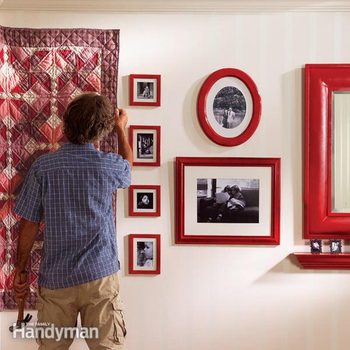
Learn how to hang pictures, heavy mirrors, keyhole shelves and quilts so that they're e'er direct, level and rock solid, no matter where you put them.
Y'all might as well like: TBD
Hang pictures direct and level
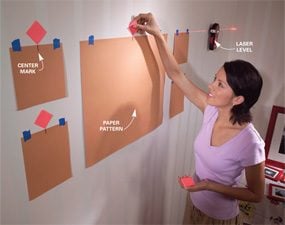
Photograph one: Level and align
Project a level line and tape exact-size paper patterns on the wall. Mark the top center of each pattern with the corner of a gummy note.
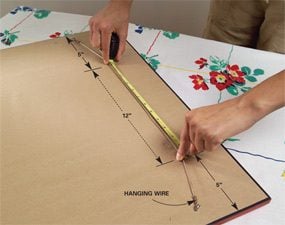
Photo ii: Find hanger locations
Stretch the hanger wire with two fingers spaced every bit afar from the edges of the picture show frame. Go along the wire parallel to the summit of the frame. Measure the distance between your fingertips.
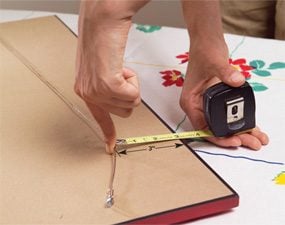
Photo 3: Find the distance from the top edge
Get out one finger in identify and measure from the wire to the summit. Use this dimension and the dimension from Photograph ii to position the picture hangers.
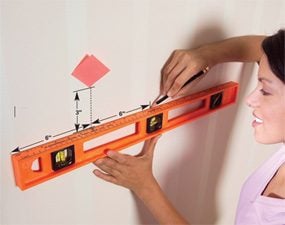
Photo 4: Transfer measurements to the wall
Find the hanger positions by measuring downwards from the sticky note and to each side from the centre. Keep the hangers level.
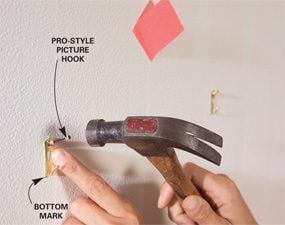
Photograph 5: Smash hooks
Marshal the bottom edge of a picture claw with the mark and drive a smash through the hook's guide.
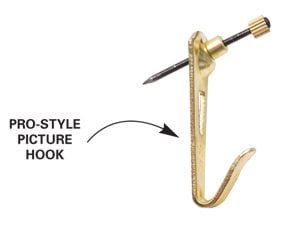
Pic hook
Use heavy-duty picture hooks
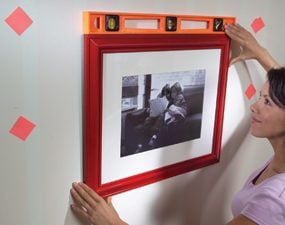
Photo 6: How to hang a picture frame
Slip the wire over both hooks. Slide the picture sideways across the wires until it's level. Use the same process to hang the remaining pictures.
The first claiming in hanging a motion-picture show is deciding exactly where you want it. It's not so difficult with just one picture. You can ask a helper to agree it upwards while you stand back and approximate the position.
Most experts recommend hanging a moving picture with its center almost 60 in. from the floor, or bottom edge six to 8 in. higher up a piece of furniture. Utilise these heights as a starting point. And so adjust the position of the picture show to your liking, and mark the top center with the corner of a sticky notation. Apply the technique shown in Photos ii – vi to complete the job.
A group of pictures is trickier. Showtime cut out paper patterns and arrange them on the wall with low-adhesive masking tape. The temporary red line from a laser level is helpful for aligning a series of photos level with one some other (Photograph 1). The laser level is ideal because you go a perfectly directly line without having to mark up the walls. A standard carpenter'southward level will also piece of work.
When yous arrive at a grouping that's pleasing, mark the top center of each pattern with the corner of a mucilaginous note (Photo 1). You'll use the bottom corner of each sticky annotation every bit a reference point for locating the picture hangers.
Now you're ready to position the picture hangers (Photos two – 4). Use ii hangers for each picture for extra support and to assist keep the picture from tipping. Choose picture hangers that are rated to support the weight of your art. We recommend professional person hangers similar the one shown in Photograph five. They work fine in drywall. These are available at abode centers or from most film-framing shops. Plaster may not support pictures besides as drywall does. To hang heavier art on plaster walls, use picture hangers with double or triple nails.
Photos 2 and 3 bear witness how to measure the space between the hangers and the distance from the tiptop of the picture frame. The distance between hangers isn't disquisitional. Simply space your fingers several inches from the outside edges of the picture frame. Transfer these measurements to the wall (Photograph four). An inexpensive level with inches marked forth the edge is a great picture-hanging tool (Photograph 4). Otherwise, simply stick masking record to the edge of a level and transfer measurements to the tape (Photo 2). Then line up the bottom of the hooks with the marks and drive the motion picture-hanger nails through the angled guides on the hooks (Photo five).
Earlier you hang the picture, stick a pair of clear safe bumpers on the back lower corners of the frame to protect the wall and help proceed the movie level. You lot'll discover these with the picture hanging supplies or in the cabinet hardware department (they're called "door bumpers").
Video: Brand a Floating Shelf Picture Ledge
How to hang heavy mirrors with confidence
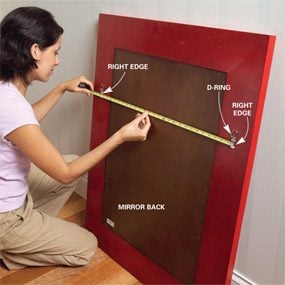
Photograph i: Find middle-to-center altitude
Measure from the correct edge of one D-ring to the right border of the second D-ring to observe the exact distance between the centers of the hanging D-rings.
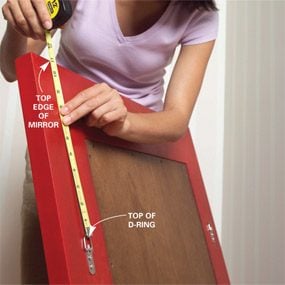
Photo 2: Discover distance to top
Measure out from the top of the D-ring to the pinnacle of the frame to decide the distance downwards.
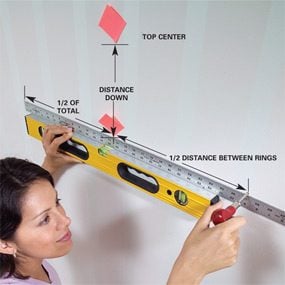
Photo 3: Transfer measurements
Use a level and a ruler to plumb down the correct distance. Mark the spot with the corner of a gluey note. Then utilize the level and ruler to find the exact hanger positions.
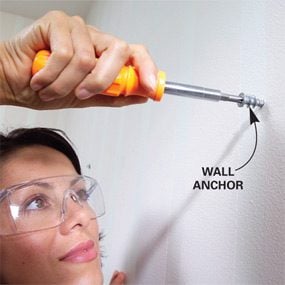
Photo 4: Drive anchors
Drive a wall anchor into the drywall at each hook location.
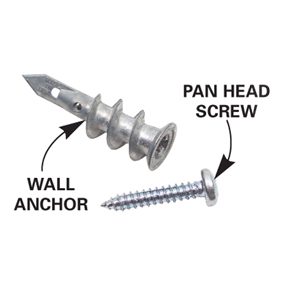
Wall anchor
Screw in anchors hold amend than plastic anchors in drywall.
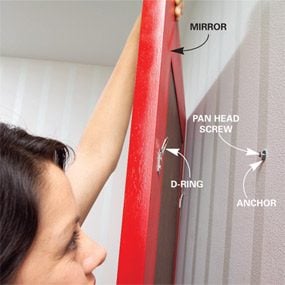
Photo v: Hang the mirror
Screw a pan head screw into the anchor. Leave the screw sticking out about 1/4 in. Hook the D-rings onto the protruding screws.
Take extra precautions when yous're hanging a heavy mirror. If the mirror has a hanging wire on the dorsum, remove information technology and instead screw D-rings to the frame (Photo 1). (Mirrors without frames should exist hung with special mirror hangers.) Locate the D-rings an equal distance from the top of the frame, about 1-third of the total peak down. Then measure out the verbal altitude between the centers of the D-rings (Photo 1). The play a joke on is to hook your tape measure on one edge of a D-band, and measure out to the aforementioned edge of the second D-ring. Record this measurement. Then measure downwards to the top of the D-rings (Photo two).
Photo three shows how to transfer the measurements to the wall. But first, you'll have to hold the mirror upwards to the wall and choose the best position. Start with the center of the mirror at near 60 in. from the floor. When you lot like the position, marker the superlative middle with a sticky note.
Some picture hangers are rated to back up heavy mirrors, but information technology'due south stronger and safer to install hollow-wall anchors instead. We recommend the screw-in type anchor shown in Photo 4. Information technology'due south rated to support xl lbs. Weigh your mirror and choose the appropriate type of anchor. Use toggle-type anchors for heavier mirrors. Measure from your reference point to position the anchors (Photograph 3). Brand starter holes with an awl or Phillips screwdriver. If you hit a stud with the awl, simply drive a screw. Photo five shows how to hang the mirror. If the top isn't level when you lot're done, wrap a few turns of electric tape around the D-ring on the depression side to heighten that side slightly.
Marshal keyhole-slot shelves
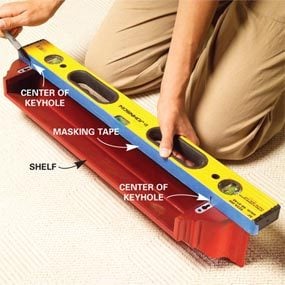
Photo 1: Mark keyhole locations
Stick masking tape to the edge of your level and marking the keyhole centers on the record.
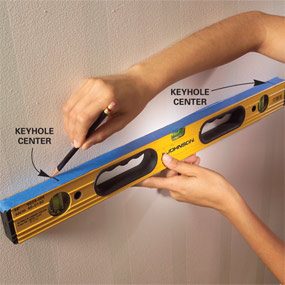
Photo 2: Marking screw locations
Place the level against the wall at the desired shelf height. Arrange it to level it and mark the wall at the two keyhole locations.
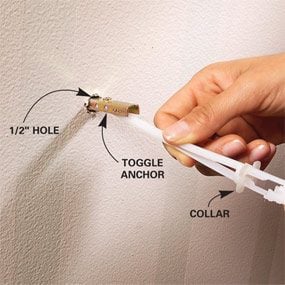
Photo iii: Insert toggles
Drill a pigsty into the drywall at each marking and slip the toggle through the hole. Push in the plastic collar tight to the drywall.
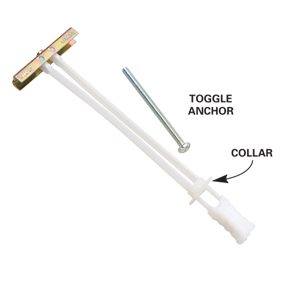
Toggle anchor
Toggle anchors are easy to use and support up to 100 lbs.
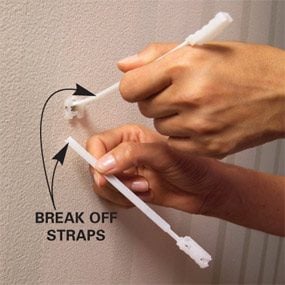
Photo four: Break straps
Then intermission off the straps flush with the collar.
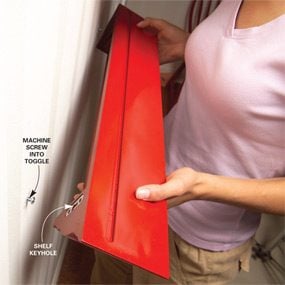
Photograph v: Hang the shelf
Drive the included auto screw into the toggle, letting information technology protrude near 3/16 in. Test-fit the shelf.
Many lite-duty shelves have keyholes in the dorsum. The keyholes slide over protruding screws for support. The trick is to precisely place the screws and then they marshal with the keyholes.
Photos ane – five shows a foolproof method that doesn't require any measuring or math. Photo 2 shows a trick for transferring the keyhole locations to the wall. If the mounting screw locations don't land over studs, use wall anchors to back up the shelf. Nosotros're using a slick toggle-type anchor that holds 60 to 100 lbs. and is easy to install. This brand is available at virtually home centers. Make certain the screw heads supplied with the anchor fit the keyhole slot before you install the ballast. Otherwise go to a smaller size anchor.
Drill holes for the anchors at each mark and mount the anchors in the wall. Let the screws beetle enough for the keyholes to slide over them. Test-fit the shelf by adjustment the keyholes with the screws and sliding it down. If the shelf won't slide on or is too loose, remove the shelf and accommodate the screws until y'all go a snug fit.
Hang a quilt without damaging it
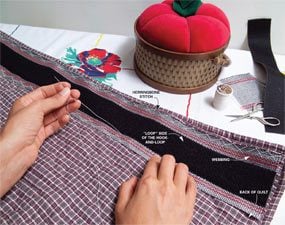
Photo 1: Stitch on the loop
Sew together the loop side of the hook-and-loop to the webbing. So sew the webbing to the back of the quilt using a herringbone stitch every bit shown.
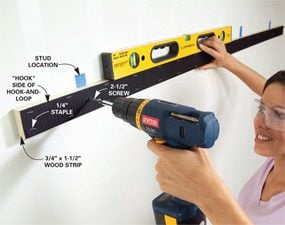
Photo 2: Fasten the hook side
Staple the hook side of the hook-and-loop to the woods strip. Determine the best position, and level the woods strip and screw it to the studs.
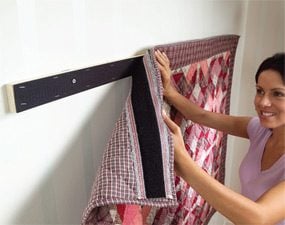
Photograph three: Hang the quilt
Hang the quilt by smoothing the hook-and-loop tape that'due south sewn on the back of the quilt forth the tape stapled to the wood strip.
One good fashion to brandish a quilt is to hang it on a wall. But don't just tack it upwardly past the corners or it'll stretch out of shape. Instead, use this method for hanging quilts or other decorative textiles considering it distributes the weight evenly for smooth hanging and minimal stress to the fabric. The hand stitching (Photo ane) used in this method doesn't damage the quilt because it only goes through the backing, and it's easy to remove when you no longer wish to display the quilt.
Measure out the top border of the quilt and purchase the same lengths of ane-1/two-in.-wide sew-on hook-and-loop fastener strip and 2-i/2-in.-wide cotton wool or synthetic webbing. We found the hook-and-loop strip at a fabric store and the webbing at an upholsterer'south shop. You'll as well need a length of 1-1/2-in.-wide pino or poplar, a staple gun and several 2-ane/two-in. wood screws.
Photos 1 – three show how to prepare and hang the quilt. If the quilt design allows, it'southward all-time to rotate the quilt 180 degrees every month or and then. This relieves stress on the fabric and helps prevent uneven fading. To be able to rotate the quilt, you'll take to stitch another strip of hook-and- loop along the opposite edge.
Dealing With Other Types of Walls
It's usually not hard to hang things on drywall. You can drive nails hands, and studs are simple to locate. Other types of walls nowadays unique challenges. Plaster is harder than drywall and can crumble. But the pros nosotros talked to say as long as y'all use professional picture hangers similar the ones we testify hither (these accept sharper nails and built-in bending guides), and use hangers a little larger than required, you'll usually be OK. In brick or stone, y'all can frequently drive a thin smash into the space between the mortar and the brick or stone. In brick, stone and concrete, y'all want to avoid making large holes because they're virtually impossible to hide if you move the picture. A good method for brick, stone or concrete walls is to drill a hole that'due south slightly smaller than the threaded function of a drywall screw. Use a masonry bit in a hammer drill and drill the hole at a slight downward bending. And so thread the screw into the hole, leaving about ane/iv in. sticking out for utilize every bit a hanger.
Video: How to Use a Tape Measure
You can use a tape measure out for more things than just measuring. Travis Larson, senior editor at The Family Handyman, will show you how to use a record measure out to save time on your next projection.
Required Tools for this Project
Take the necessary tools for this DIY project lined up earlier you start—you'll relieve fourth dimension and frustration.
You'll also demand a laser level, scissors and needle and thread.
Required Materials for this Project
Avoid last-minute shopping trips by having all your materials ready alee of time. Here'south a list.
Originally Published: June 24, 2019
smallwoodharing91.blogspot.com
Source: https://www.familyhandyman.com/project/level-hanging-hang-artwork-and-wall-hangings-straight-and-level/
0 Response to "How to Anchor Heavy Odd Shaped Art on Wall"
Post a Comment